Showing posts with label yeast. Show all posts

Sunday, March 17, 2013

Stout Bread

Sláinte!

On a day inundated with Guinness cupcakes and corned beef, I opted to offer you something a little different.  Dry Irish stouts make a mighty appearance on St Patrick's day.  So in honor of this dark malty beverage, I baked up bread that shared that same deep, roasty flavor.  The key is in the addition of dark dry malt extract.  The darker the better. 

 This brewing ingredient lends a darker color and the roasted, malted flavor usually associated with this dark beer style.  The original recipe called for wheat bran to add a little extra body.  Instead, I substituted some spent grain from our last batch of beer,  adding even more malted complexity in addition to a wonderful whole grain texture.

Enjoy!
 
Adapted from Brother Juniper's Bread Book by Peter Reinhart

Yields three 1 1/2 pound loaves or about 36 rolls

The Ingredients:
9 cups bread flour

1/2 cup spent grain
1/3 cup brown sugar
1 cup cooked brown rice, completely cooled
1 cup dark roasted dry malt extract
3 Tbsp dry active yeast
4 tsp salt
1/2 cup buttermilk
2 cups warm water

The Process:
Combine all of the dry ingredients in a large mixing bowl.  Add the buttermilk about 1 1/2 cups of water, stirring until combined.  Turn the mess out onto a well floured work surface and knead until the dough is smooth and elastic, about 10-12 minutes, adding additional water as needed.

To use a stand mixer, transfer about half of the dough to the mixing bowl and knead with a dough hook for about 5 minutes.  Combine the two dough balls, and knead by hand a minute or two to combine.

Transfer the dough to a clean, lightly greased bowl.  Cover and allow to rise until doubled, about 45 minutes to 1 1/2 hours.

Once the dough has doubled in size, turn it out onto a clean work surface.  For loaves, divide  the dough into thirds, gentle fold into a loaf shape and place in 9 x 4 x 3 inch pan.  For rolls, divide dough into 36 balls.  Gently rolls into balls and place in a 9 x 13 inch baking dish, spacing them about 1- inch apart.  Approximately 12 rolls will fit per dish.  Brush with an egg wash.  Loosely cover aan allow to proof until double in size, about 1 hour

Preheat the oven to 350.

Bake the rolls for 10-15 minutes and loaves for 45 minutes or until golden brown and sounds hollow when tapped.  Transfer to a wire rack to cool.  Allow loaves to rest at least thiry minutes before slicing.


Monday, December 3, 2012

Hefeweizen Honey Rolls

As a home brewer an beer aficionado, it hardly seems appropriate for Thanksgiving to came and go without some dish using beer.   At first I thought I'd skip the rolls. I already had quite a bit of cooking on my plate.   As the day drew closer I agreed that perhaps some frozen rolls could find their way onto our table.  It wasn't until Jackie at the Beeroness posted her hefeweizen rolls that I know there was no way around it.  I was going to be baking my own rolls.

And I couldn't have been happier about it.

I've heard from more than one source that powder milk creates an incredibly tender roll.  It is the secret to Portuguese sweet bread.  And the beer, aside from adding a bit of flavor, aides in the leavening.  These rolls are so worth it.  You may want to pull them out for more than the occasional holiday.

Adapted from Jackie at  thebeeroness.com

The Ingredients:
1/2 cup heavy cream
1/4 oz active dry yeast
5 cups bread flour
1/4 cup dry milk powder
1/4 tsp salt
2/3 cup beer
4 eggs
4 Tbsp honey
4 Tbsp butter, softened

for the glaze:
4 Tbsp butter, melted
1 tsp honey
1/2 tsp coarse salt

The Process:
In a microwave safe dish, heat the cream in 20 second increments until it is about 110 degrees. Add the yeast and set aside until foamy, about 5 minutes

In a medium bowl sift together the flour, salt and dry milk powder. Add the cream and the beer, mix until just combined.  Add the eggs one at a time, mixing thoroughly between additions.  Add the honey and butter and stir until combined. Turn the dough out onto a clean work surface and knead for 10-12 minutes or until the dough is smooth and elastic and no longer sticky.

Coat the inside of large bowl with oil. Form the dough into a ball place in the bowl. Cover the bowl tightly with plastic wrap and allow to rise in a warm room until doubled in size.

Turn out the down onto a clean work surface and knead lightly for about 1 minute.

Cut the dough in half, then cut each half in again to form 4 equal sized pieces. Cut each piece in half to create 8 equal sized pieces. Cut in half again to create 16 dough balls.

Roll each piece of dough into balls, place into a baking dish with a bit of space between each roll.  Cover and allow to rise until about doubled in size.

Heat oven to 400 (the perfect time is right after the turkey has been removed to rest)

Combine the melted butter and honey. Brush the top of the rolls with honey butter mixture, sprinkle with salt.

Bake at 400 for 12-15 minutes until golden brown.


Monday, November 12, 2012

Bavarian Pretzel Bites with Beer Cheese Dip

Beer and pretzels.  When Ross and I set the date for our homebrew tasting, Bavarian pretzels were high on the list.  Whilet we were not serving any Martzen or lagers, this soft, chewy Oktoberfest staple seemed only fitting as our finger food and palate cleanser offering.  I scoured several recipes and came across many, many variations.  Most were of a quick and easy variety...attempting to replicate the slightly sweet and overly gresased varieties found at many a mall and corner cart.  Not Bavarian pretzels to say the least.

I had visions of soft, chewy, almost bagel-like interiors caramelized into a leathery, blistery brown skin, dotted with salt and full of pungent yeasty flavor.  Most recipes treated pretzel dough like bread dough...only with shorter to no proofing time and usually relying on egg washes to achieve the exterior.  Somehting didn't bode right about these.

Eventually a reoccuring method begin to pop up among recipes claiming to be more traditional or old world.  Lye.  Baking soda.  Alkalies....

It seems the trick to that memorable chwey interior and gorgeous brown skin is to boil the pretzels in an alkil solution for a mere 20 30 seconds.  In that breif moment the high pH breaks down the surface starches in to much more simple sugars which in turn caramelize in mere minutes in the oven.  The lye is food grade and can be purchased commercially...the heat of thee oven burns off any remaining, so fear not.  I found baking soda worked wonderfully.

The pretzel dough does dry out quickly.  I found having a spritzer of water at hand helped immensely when trying to roll out the ropes.  I did not try my hand at twisting traditional knots.  I did have over thirty people to supply...bite-sized bits seemed far more appropriate.  The recipe will make twelve 8-inch pretzels for the more ambitious. 

The baking soda is intimidating, but so much fun as well.  Dropped the bites in about 8 at a time.  They puffed up like magic within moments, supercharging the yeast before their trip into the oven.  The bite of residue alkali left had a cleansing effervescent quality unlike anything I've ever tasted with an American-style pretzel.  I am eager to try these babies again!

DO use parchment paper.  I learned that the hard way after trying to pry the baked morsels off of the first baking sheet.

DO remmeber to salt them before you bake them, using coarse or sea salt, not kosher salt.  Salt will not stick after the pretzels are baked, even with a brushing of oil, butter or beer. 

DO use the full amount of yeast.  2 Tbsp seems like a lot.  It is.  I snipped the tops off three packages and stirred the whole mess in.  You want the yeast. 

DO make these time and time again.  They will be a huge hit.  One guest, recently recovered from a trip to Germany, insisted I send her the recipe.  She found nothing quite as close to traditional Bavarian pretzels since returning state side.  The

pretzels adapted from the New York Times
Beer cheese dip adapted from Girlichef

yields 96 pretzel bites

The Ingredients:
for the pretzels:
1 Tbsp barley malt syrup or dark brown sugar
2 Tbsp lard or softened unsalted butter
2 Tbsp instant yeast
6 cups bread flour
1 tablespoon  kosher salt
5 cups water
10 Tbsp baking soda
Coarse sea salt or pretzel salt, for sprinkling (do not substitute kosher salt)

for the dip
10 oz beer (preferably a hefeweizen)
2 cups shredded cheddar cheese
1 Tbsp  flour
8 oz. cream cheese, softened
1 clove garlic, minced
2 green onions, finely chopped
2 tsp Dijon mustard
salt and pepper to taste

The Process:
In a large  bowl stir together syrup or brown sugar, lard or butter, yeast, 2 cups warm water and half of the flour. Add kosher salt and remaining flour and stir just until mixture just comes together.

Turn out the dough onto a clean work surface and knead for 8 to 10 minutes, until smooth and elastic. Cut into 12 pieces, gently form into balls and loosely cover with cling wrap.  Let rest 5 minutes.

Roll out each piece into a rope about 18 - inches long.  Cut each rope into approximately 8  pieces.  Place on baking sheets and loosely cover with cling wrap. Let rest at room temperature for 30 minutes, then refrigerate for one hour

Pre-heat oven to 425.

In a large saucepan mix the water with baking soda. Bring to a boil. Working with about a dozen at a time, place pretzel pieces in the boiling solution for 20 seconds. remove with a slotted spoon and spread out the pieces on a parchment lined baking sheet. Sprinkle with pretzel salt.

Bake for 8-10  minutes or until golden brown.

Serve immediately.

for the dip


In a medium saucepan set over medium heat bring the beer to a gentle boil.  Toss the cheddar cheese with the flour. Once beer is simmering, whisk in the cheese,cream cheese, mustard, green onions and garlic.  Continue to stir until the cheese has melted and the sauce is smooth. Season with salt and pepper to taste. Keep warm until ready to serve.

Thursday, April 12, 2012

Honey Kissed Hot Cross Buns


When I was little, perhaps 6 or 7, my sister traveled to Denver for the Suzuki Institute.  She was already quite the violin player.  My parents brought me along for the ride, though I didn't play anything at that point.  So what is a 6 year old to do at a huge music gathering like this while her big sister hones her string playing prowess?  Well, pick up the penny whistle of course!

Of all the things that I experienced that week, the little ditty they taught us to play on the penny whistle stuck with me (well, that and memories of hiding in the basement of a strange building as a huge tornado descended  into downtown Denver...that was quite a year).

Hot cross buns, 
hot cross buns.
One a penny,
two a penny, 
hot cross buns

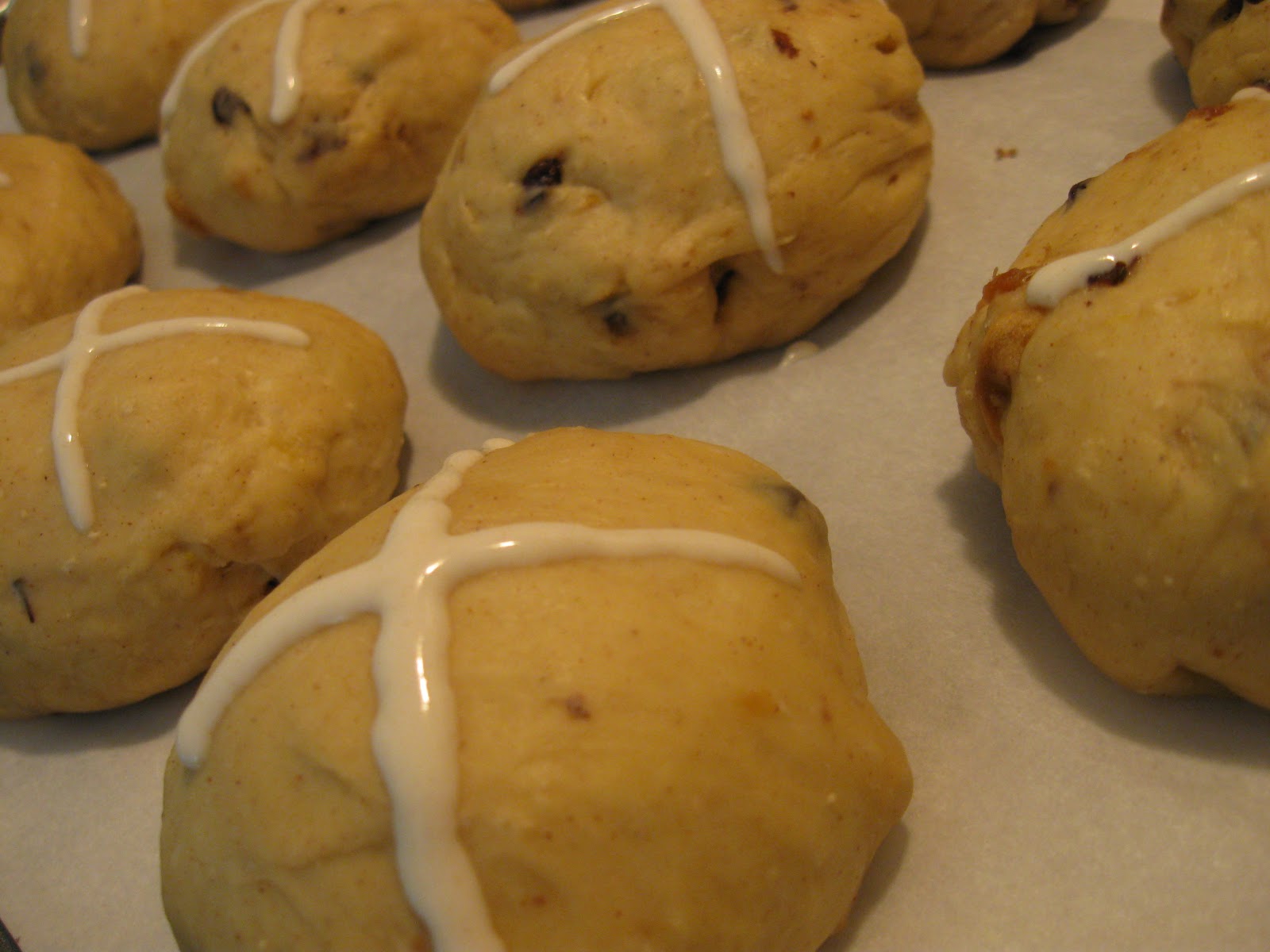
I remember that song so well, but I cannot recall ever actually eating a hot cross bun.   This Easter season I wanted to give these spicy rolls a shot...and further improve my rapport with yeast.   This recipe is loaded with diced dried fruit well beyond the scope of traditional raisins.  Brushed with honey straight out of the oven they have the most heavenly glow!  Perfect for that Easter Brunch!  Even if it is celebrated a few days late...

adapted from Hester's recipe at Alchemy in the Kitchen

yields 12 buns

The Ingredients:
3 1/2 cups bread flour
1 tsp salt
3/4 tsp ground cinnamon
1/4 tsp allspice
1 tsp grated orange zest
7 g dry active yeast  (1/4 oz package)
1 Tbsp olive oil
1/2 cup mixed dried fruit (apricots, apples, prunes, figs, etc) finely diced
1/3 cup raisins, currants or dried cranberries
1/4 cup honey
1 1/4 cup milk
1 large egg

for the cross:
3 Tbsp flour
2 Tbsp water

for the glaze:
1 Tbsp honey

The Process:
 Into a large bowl combine the flour, salt, cinnamon, allspice, yeast, olive oil, and dried fruit. Mix well.

Pour the milk into a small saucepan over medium heat.  Whisk in the honey and stir until dissolved.  Warm the milk to between 80 to 95.

Make a well in the center of the flour mixture and add the beaten egg, and about half the milk. Slowly add the remaining milk, stirring and folding to completely moisten the flour.  The dough should start to pull away from the sides of the bowl. 

Turn the dough out onto a lightly floured surface, adding more flour as necessary.  Knead for 8 to 10 minutes until the dough is smooth and no longer tacky. Form into a ball and place in a lightly oiled bowl.  Cover and allow to rise until double in size, about 90 minutes

After the dough has risen, turn it out onto a lightly oiled work surface.  Divide the dough in half, and half again to form four equal portions.  Gently pull each portion into a log, about 2 inches in diameter and 6 inches long.  Using a sharp knife or kitchen shears, cut each portion into 3 equally pieces.  Roll each portion into a ball, trying to pull the dough taunt on one side.  

Line a baking sheet with non-stick baking parchment.  Place the buns on the sheet, spacing about 1 1/2-inch apart.  Gently push down to flatten, ever so slightly.  Cover the buns with cling wrap and allow to rise undisturbed until doubled, about one hour.

To make the paste for the cross, in a small ziploc bag combine the flour and water.  Massage the bag until a uniform paste is formed.  

Preheat the oven to 375.

When the buns have doubled in size, remove the cling wrap.  Snip a corner off of the ziploc bag containing the flour paste (the less you snip off, the finer a point you will have for piping). Carefully pipe a cross over the top of each bun. 

 Place the buns in the oven and bake for 12 to 15 minutes or until golden brown. Transfer the buns to a cooling rack and immediately brush them with warmed honey.

The Review:
Warm, welcoming and just kissed with sweetness!  Just the look of these is a far cry from the royal icing laden varieties sold at the supermarkets during the spring.  It is almost a pity they are only sold around the Easter season.  They make the perfect breakfast roll..spicy, studded with fruit and not terribly sweet.  The yeasty smell tempted us the entire drive to our friends as we took a batch along for Easter dinner.  Paired with ham?  Heavenly.  But these buns are certainly sinful in their own rite.

Thursday, March 15, 2012

Multigrain Bread Extraordinaire

One of my goals for this, the second year of my blog, was to attempt more yeast leavened baked goods.  More specifically, breads.  I have a love/hate relationship with yeast.  I love the tang it gives to beers and breads.  I marvel at how this simple organism can create such complex flavors as it breaks down sugars and carbs.  To date, our beer brewing adventures have yielded one successful batch after another.  But on the bread front...

Cinnamon rolls, monkey breads, sticky buns...all of those seemingly complicated (at least as far as assembly is concerned) yeast-based baked goods turned out well.  For my first true attempt at bread last year I opted for what seemed like a much simpler, more straightforward bread...the baguette.  It failed miserable.  The dough did not want to rise a second time.  It finally doubled up enough to justify baking it.  Into the oven three loaves went.

What came out I would hesitate to call bread.  The sticks of dough were ghastly pale, not the scrumptious golden brown I anticipated.  It was very toothsome...almost to the point of tooth shattering.  Never had I encountered a crust that rock solid.  Once I managed to chisel my way through the yeasty armor, no tender crumb but lifeless dry mass greeted me.

The bread was not even fit for bread crumbs or stuffing.  Not even the birds would touch it.

Needless to say, I've put off trying my hand at a loaf of bread for a long time because of those anemic baguettes.

But I made a resolution, and I can't put off attempts at bread too much longer.  I had originally planned to start simple again...a white or wheat.  But I opted to make a bread I would want eat, and I'm not really a white bread kind of girl.

After thumbing through Peter Reinhart's Bread Baker's Apprentice, I found a loaf a step up from basic white and wheat sandwich breads: Multigrain Extraordinaire.  The part of the recipe that called to me was the multigrain soak...three grains with many available substitutes.  The recipe below details the combination of grains I used; but millet, amaranth, buckwheat, triticale flakes, wheat bran, and rolled wheat are options as well.

adapted from Peter Reinhart's The Bread Baker's Apprentice

yields one 2-pound loaf

The Ingredients:
for the soaker (prepared the night before)
3 Tbsp quinoa
3 Tbsp rolled oats
1 Tbsp wheat germ
1 Tbsp coarse cornmeal
1/4 cup water, room temperature

for the dough
2 cups high-gluten or bread flour
1 cup whole wheat flour
3 Tbsp brown sugar
1 1/2 tsp salt
1 Tbsp instant yeast
3 Tbsp cooked brown rice
1 1/2 Tbsp honey
1/2 cup buttermilk
3/4 cup water, room temperature


optional topping
1 Tbsp sesame or poppy seeds

The Process:
for the soaker
The day before making the bread, combine the quinoa, wheat germ, rolled oats, coarse cornmeal and water in a small bowl.  The water will just moisten the grains.  Cover the bowl with plastic wrap and allow to rest overnight at room temperature.

for the bread:
In a 4-qt bowl sift together the flours, brown sugar, salt and yeast.  Add the brown rice, soaker, honey, buttermilk and water.  Stir until all of the ingredients form a ball...adding water a few drops at a time if any flour remains on the bottom of the bowl.

Sprinkle the work surface with flour and turn out the dough.  Knead by hand for 12 to 15 minutes, sprinkling with extra flour as needed.  The dough should be soft and pliable, tacky but not sticky.  Form the dough into a ball and place in a lightly oiled a bowl.  Mist lightly with oil.  Cover with plastic wrap.

Allow the dough to ferment a room temperature for 90 minutes or until roughly double in size.


Remove the dough from the bowl.  On a lightly floured work surface shape the dough into a 6 by 10 inch square.  Starting with the short side, gently fold the dough onto itself, squaring the edges to form the loaf. Place in a lightly oiled metal loaf pan with the seam down.  Mist the loaf with water and sprinkle the  sesame or poppy seeds on top.  Lightly mist with oil.  Loosely cover the loaf pan with plastic wrap.

Proof the loaf for approximately 90 minutes or until roughly double in size.  The dough should crest fully above the top of the pan by almost an inch at the center.
Preheat the oven to 350.

Place the loaf on the middle rack in the oven, and bake for 20 minutes.  Rotate the pan 180 degrees and continue to bake for an additional 20-40 minutes, or until the bread registers between 185 and 190 on a thermometer and sounds hollow when lightly thumped.

Once finished baking, immediately remove loaf from pan and allow to cool and a wire rack for at least one hour prior to slicing, preferable two.  This allows additional moisture to evaporate, the starches to settle and prevents the loaf from appearing under-baked or soggy.

The Review:
Success! Not a raving, stop the press sort of success, but a huge step towards no longer fearing yeast. 

The starter was an interesting technique.  Most of the grains were very much intact when the time came to start the dough.  The scent of the quinoa was by far the most prominent.  Even overpowering the yeast as the bread fermented and proofed.  At least until the bread stating baking.  Then the kitchen was filled with that welcoming warm scent of nostalgia and a hundred visits to the bakery with Mom or Grandma.

What was surprising was that all of the grain, short of the quinoa, broke down and dispersed thoughout the dough.  I was expected a grain flecked loaf of health and was instead treated with a fluffy and tender treat.  The little kernels of quinoa were the only discernible texture.

The crust was a little thicker and crisper than I would have liked...making it a bit hard to saw through the first slice.  But the crust succumbed to the bread knife and yeilded the soft interior...still warm after two hours of cooling. 

The grains offered a light nutty flavor.  I'd love to experiment with the other grains to see what additional flavors can be coaxed out.  Nuttiness was accented by the wonderful sweetness of the honey and brown sugar.  The bread was divine sliced and slathered with sweet cream butter.  It was just as wonderful for dinner, serving as the base for a hearty BLT of thick cut bacon.


Sunday, March 4, 2012

Belgian-style Yeast Waffles

Happy Sunday!  Ross was fortunate enough to have another Sunday morning at home, so thus the waffle tradition continues.  I have tried quite a few varieties of waffles to date, but none of the traditional TRUE Belgian-style waffles using yeast. Our puppy was kind enough to wake me up a good two hours before Ross this morning so I was able to get the batter fermenting early enough that he wasn't teased with the thought waffles before they were ready to cook.  AND I got to crawl back into bed for a while. If you'd rather have waffle batter ready to pour and go, the batter can be made ahead of time and refrigerated overnight.  I'd love to try both time frames to see how the flavor truly develops...

adapted from King Arther Flour

Yields 4 Belgian-style waffles (dependent on the waffle iron)

The Ingredients:
1 1/2 cups lukewarm milk, divided
1 1/2 tsp instant yeast
6 Tbsp butter, melted
2 to 3 Tbsp sugar
1/2 tsp salt
1 tsp vanilla extract
2 large eggs, room temperature, separated
2 cups all purpose flour

The Process:
In a small bowl or measuring cup, dissolve the yeast in 1/4 cup warm milk. Set aside for 10 minutes, or until the yeast begins to foam.

In a large bowl, whisk together the egg yolks, 1/4 cup of the warm milk and the melted butter. Stir in the yeast mixture, sugar, salt and vanilla. Blend in the remaining milk alternately with the flour, ending with the flour. 

In a separate mixing bowl with an electric beater, or by hand with a strong wrist action, whisk the egg whites until they hold soft peaks.  Fold the whites gently into the waffle batter, until just combined.  Do not over mix!  The batter should retain as much air as possible from the whites.

Cover and allow to rest for about 1 hour or until doubled in size.  The batter may also be prepared the night before and refrigerated at this point.


Preheat oven to 250 and warm up the waffle iron.

Brush or mist the waffle iron lightly with oil and spoon batter into waffle iron, spreading quickly with a spatula to cover the entire griddle surface (amount varies depending on waffle iron, due to the amount of air in the batter, mine iron used about 1  cup, instead of the usual 1/2 cup). Cook according to iron manufacturer’s instructions.


Transfer waffles to rack in oven to keep warm and crisp. Make more waffles in same manner.

Serve warm, garnished with fruit and whipped cream, dusted with powder sugar, or simply with butter and syrup.

The Review:
Uncovering the bowl of batter and ladling it into the iron was like walking into the front dough of a bakery.  That welcoming, yeasty aroma filled the kitchen and helped coax Ross out of bed.  These waffles were unlike any of the others I've tried to date.  The exterior was much crisper than the non-yeast varieties.  And that crispness held up better to the barrage of syrup and butter.  Yet the waffle still yielded and sopped up all of the sweet goodness drizzled on top.


These waffles are not sweet.  They were not reminiscent of funnel cakes like so many previous waffles had been.  The flavor was deeper, richer...and...well...yeastier.  The yeast was subtle, at least to me.  Those not fond of the flavor may find it more overbearing than I did.  The yeast lent a wonderful depth and complexity, almost a tartness, to the waffles.  The interiors were lighter than air, but not in the least bit fluffy.  Almost creamy...

With the deeper yeast flavor and more substantial body, I think I have discovered my go-to waffle for the next beer and waffle gathering.  The #8 Belgian style ale we brewed is about ready to crack open...

Monday, January 2, 2012

Sticky Buns

I have been promising Ross a batch of sticky buns for quite some time now.  What better way to ring in the New Year than by biting into a warm cinnamon-y bun for breakfast.  Unfortunately, the previous night's revelry and the yeast's stubbornness meant we weren't able to enjoy the buns until almost five in the afternoon.  But it was still a wonderful treat to mark our snowy new year.

And if you have a moment...take peek at a lovely sweets blog I was recently introduced to:
Sweet as Sugar Cookies

adapted from The Bread Baker's Apprentice by Peter Reinhart

makes 8 to 12 large or 12 to 16 smaller buns

The Ingredients:
6 1/2 Tbsp granulated sugar
1 tsp salt
5 1/2 Tbsp shortening or unsalted butter at room temperature
1 large egg
1 tsp lemon zest
3 1/2 cups unbleached bread or all purpose flour
2 tsp instant yeast
1 1/8 to 1 1/4 cups whole milk or butter milk, at room temperature
1/2 cup cinnamon sugar (6 1/2 Tbsp sugar + 1 1/2 Tbsp cinnamon)

Caramel glaze
1 stick unsalted butter, softened
1/4 granulated sugar
1/4 cup packed brown sugar
1/4 cup corn syrup
1/4 tsp salt
1/2 tsp orange, lemon, or vanilla extract

 crushed walnuts or pecans (optional)


The Process:
*In his book, Reinhart goes into amazing depth about what each ingredient does as well as what happens during every step of the bread making process. It is certainly worth while reading, but is a bit too much info for a single recipe.*

Cream together the sugar, salt and shortening on medium-high speed in an electric mixer with a paddle attachment (or by hand with a large metal spoon). Whip in the egg and lemon zest until smooth. Then add the flour, yeast, and milk. Mix on low speed (or stir by hand) until the dough forms a ball. Switch to a dough hook and increase speed to medium, mixing for approximately 10 minutes (or knead by hand for 12 to 15 minutes), or until the dough is silky and supple, tacky but not sticky. Lightly oil a large bowl and transfer the dough to the bowl, rolling it around to coat it with oil. Cover the bowl with plastic wrap.

Ferment at room temperature for approximately 2 hours, or until the dough double in size.


Meanwhile prepare the caramel glaze.  In a medium bowl cream together the butter, granulated sugar, brown sugar, and salt for about two minutes.  Add the corn syrup and extract of your choice.  Continue to cream by hand or with an electric mixer for an additional five minutes, or until light and fluffy.


Coat the bottom of a 9 x 13 inch baking dish (with sides at least 1 1/2 inch high) with a 1/4-inch layer of the caramel glaze.  Sprinkle the glaze with nuts, if desired.  Set aside.

Once the dough has doubled in size, mist the counter with spray oil and transfer the dough to the counter. Roll out the dough with a rolling pin, lightly dusting the top of the dough with flour to keep it from sticking to the pin. Roll it into a rectangle about 2/3 inch thick and 14 inches wide by 12 inches long for large buns, or 18 inches wide by 9 inches wide for small buns. Don't roll out the dough too thin, or the finished buns will be tough and chewy rather than soft and plump. Sprinkle the cinnamon sugar over the surface of the dough and roll the dough up into a cigar-shaped log, creating a cinnamon-sugar spiral as you roll. Will the seam side down, cut the dough into 8 to 12 even pieces each about 1 3/4 inched thick for large buns; or 12 to 16 pieces each 1 1/4 inch thick for smaller buns.

Place the buns approximately 1/2 inch apart on top of the prepared caramel glaze . Mist the dough with spray oil and cove loosely with plastic wrap.

Proof at room temperature for 75 to 90 minutes, or until the pieces have grown into one another and have nearly doubled in size.

Bake the sticky buns for 30 to 40 minutes or until golden brown.  Remember that with sticky buns the tops will become the bottoms, so they may appear darker when done to ensure that the underside is fully baked.  

Cool the buns in the pan for about 10 minutes and then remove them by flipping them over onto another pan.  Carefully scoop any caramel remaining in the pan onto the sticky buns.  Wait at least 20 minutes before serving.

The Review:
It appears my kitchen is just too cold in the winter to properly proof bread dough.  After about an hour and a half of the dough's first fermentation, it had barely grown at all.  I mixed up a little of the yeast remaining in the envelope in water water with a bit of sugar to see if it was still viable.  It frothed up after 5 minutes or so, as it is expected to.  So, my sleepy single celled organisms must have been just a bit too cold to do their work.  I shifted the bowl of dough to the top of the fridge...the warmest spot in the room.  After an additional half an hour, the dough had finally shown some growth, but not the doubled mass I needed.  So into the slightly warmed oven for almost another hour...and finally the sticky bun dough was ready to roll out...

That was a frustrating realization.  The sticky buns still turned out absolutely amazing, but due to the trouble with rising, the end result was a bit more crumbing than the light, pillowy cinnamon buns I had made last year using the same dough recipe.  Amazing how much a variable such as proofing time and temperature can affect the final product!

The dough, though not as airy as expected, had the same wonderfully sweet, rich and clean flavor I fondly remembered from the cinnamon buns.  The little bit a lemon zest adds quite a bit of depth to the dough!  The caramel glaze melted, bubbled and boiled while baking...slowly converting from the buttery sugar spread to the wonderfully sticky goo coating the buns.  The glaze was pleasantly sticky without wearing out your jaw with chewing. 

Once I figure out the sweet spot in my cold winter kitchen to proof future doughs, I'll be making these more regularly.